
- Pages:
- 118
- Published:
- September 2022
- ISBN:
- pending
- Edition:
- 1
In Print
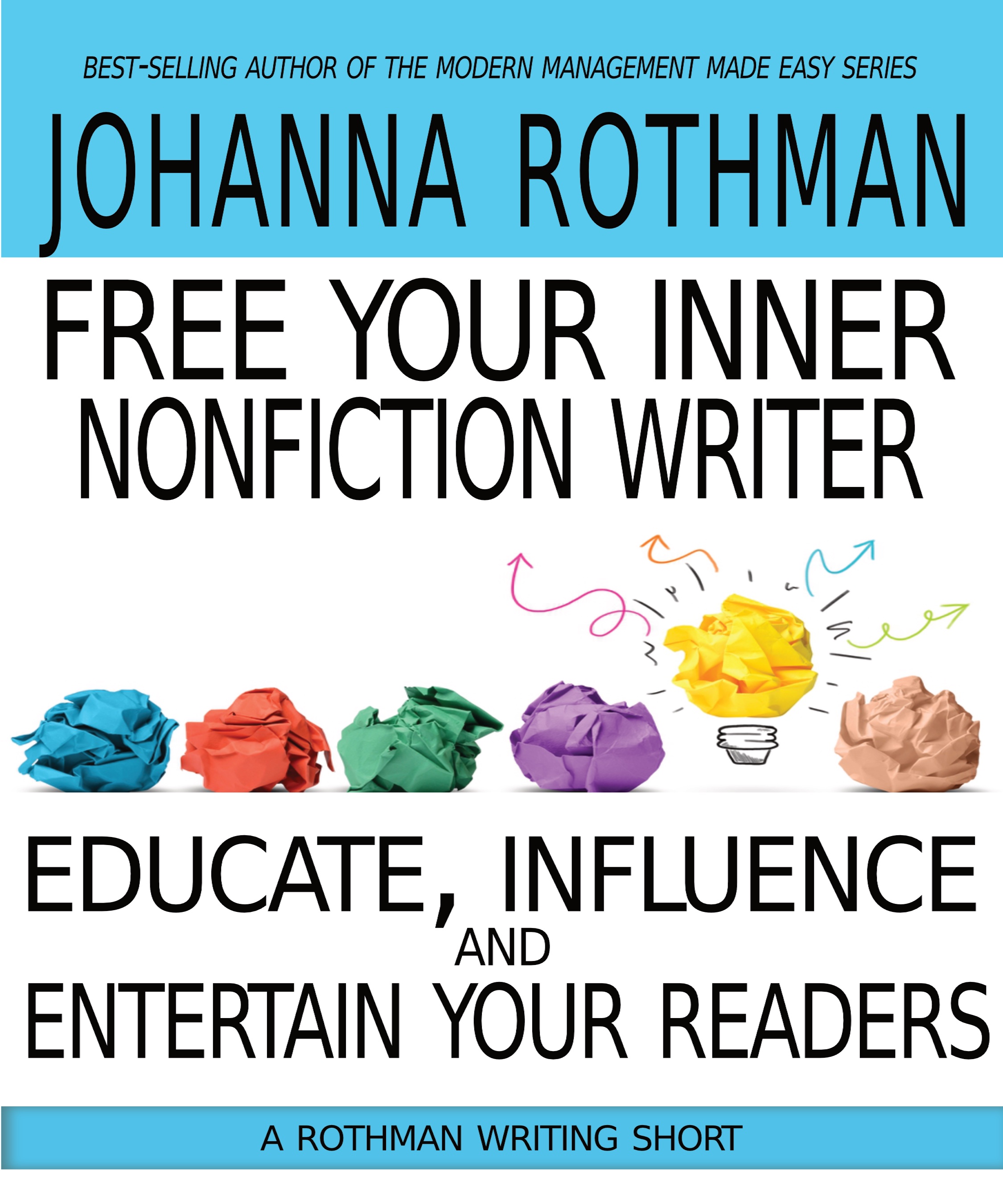
Free Your Inner Nonfiction Writer
Educate, Influence, and Entertain Your Readers
by Johanna Rothman
Learn how to write nonfiction fast and well. Start with choosing one ideal reader and help that reader understand why you’re writing this piece. You’ll learn three possible structures to organize any piece of writing, including blog posts, newsletters, and book chapters. Create and fill your idea bank with everything you want to write, from big ideas to smaller fieldstones. Learn to cycle—not edit—as you clarify your ideas. That’s because nonfiction writers learn as they write. Apply these ideas so your readers can see why your words matter.
You can learn to write fast and well—to educate, influence, and entertain your readers.
This work was written and produced entirely by the author. We are proud to be distributing it.
eBook Formats:
PDF for desktop/tablets
epub for Apple Books, e-readers
Get all eBook formats here for $9.99 (USD)

Free your inner nonfiction writer as you learn to write fast and well.
Do you want to write nonfiction better and faster? But when you try to
write, you feel stuck, or you don’t like what you wrote, or you’re not
sure why anyone would want to read your words. You can enjoy writing,
especially when you integrate thinking and learning as you write. And,
when you wait to edit until the end, you can write faster. Learn how to
educate, influence, and entertain people with your writing.
You’ll learn how to:
- Separate writing, which includes thinking and learning, from editing.
- Focus on your readers, so you write what they need to know.
- Face your writing fears.
- Find your author voice, so you sound like you.
- Be ready to write, so you never have to face a blank page.
- Empathize with your readers to write about what matters to them.
- Edit just enough.
- Evolve your writing system.
And more.
Buy this book and learn how to write nonfiction to educate, influence,
and entertain.
What You Need
N/AResources
Releases:
Contents & Extracts
- Introduction

- 1. Write to Think and Learn
excerpt
- 1.1 Writing Captures Words
- 1.2 Reset Your Writing Rules
- 1.3 Nonfiction Writers Write at Several Levels
- 1.4 Fear Paralyzes Writers
- 1.5 Manage Your Imposter Syndrome
- 1.6 Try Freewriting
- 1.7 Evolve Your Writing System
- 1.8 Practice Writing to Think and Learn
- 2. Write Fast to Write Well
- 2.1 Create Your Idea Bank and Fieldstones
- 2.2 Write What Interests You
- 2.3 Finish What You Start
- 2.4 Cycle for Clarity
- 2.5 See How to Write Fast and Well
- 2.6 Write Clean to Maintain Momentum
- 2.7 Practice Correct Spelling
- 2.8 Practice Writing Faster to Write Well
- 3. Write for Your Ideal Reader
excerpt
- 3.1 Empathize with Your Readers
- 3.2 Write About What Matters
- 3.3 Organize with the Rule of Three
- 3.4 Hook The Reader with a Problem
- 3.5 Structure Your Piece with Logic
- 3.6 End With a Reminder of the Start
- 3.7 Write In Any Order
- 3.8 Practice Writing for Your Ideal Reader
- 4. Edit Just Enough
- 4.1 Edit When You’re Still Interested
- 4.2 Maintain Your Author Voice
- 4.3 Edit as Little as Possible
- 4.4 Review Your Logic
- 4.5 Maintain Your Author Voice
- 4.6 Add References
- 4.7 Finalize Your Title
- 4.8 Practice Editing Just Enough
- 5. Choose the Feedback You Want
- 5.1 What Will Feedback Offer You?
- 5.2 Never Ask for Interim Feedback
- 5.3 When Feedback Makes Sense
- 5.4 Clarify the Value of Peer Review
- 5.5 Consider the Perfection Game
- 5.6 Use These Questions for Feedback
- 5.7 Offer Feedback with Empathy
- 5.8 Beware of Reviewer-Focused Feedback
- 5.9 Build Your Peer Community
- 5.10 Create a Writing Community
- 5.11 Practice Your Feedback Choices
- 6. Publish Your Work
- 6.1 You Own Your Writing
- 6.2 Your Employer Owns Your Writing
- 6.3 Write as Work for Hire
- 6.4 Write for Publishers Who Don’t Want Your Copyright
- 6.5 How to Work with a Professional Editor
- 6.6 Choose Your Publication Options
- 6.7 Recognize When Others Violate Your Copyright
- 6.8 Publish Widely
- 6.9 Practice Publishing Your Work
- 7. Help Yourself Succeed
- 7.1 Create Your Writing Environment
- 7.2 Count Your Words
- 7.3 Avoid Talking About Your Writing
- 7.4 Read Widely
- 7.5 Write With Others
- 7.6 Transform Your Perfection Rules
- 7.7 Watch for These Writing Traps
- 7.8 Last Words—For Now
- Annotated Bibliography
- More from Johanna
Author
Johanna Rothman, the “Pragmatic Manager,” offers frank, practical advice that you can immediately apply to your product development challenges.
She helps leaders and teams uncover effective alternatives to their current product development practices. Since one size never fits all, she works with her clients to explore options for what and how to change. The results? Leaders and teams learn to collaborate and focus on outcomes that matter.
With her trademark practicality and humor, Johanna is the author of 21 books, hundreds of articles, and thousands of blog posts about many aspects of management and product development. Find her monthly newsletter and blogs at jrothman.com and createadaptablelife.com.
eBook Formats:
PDF for desktop/tablets
epub for Apple Books, e-readers
Get all eBook formats here for $9.99 (USD)